Thursday, December 9, 2010

Culture of South Korea


South Korea is deeply affected by Confucianism!  


Confucius identified five relationships which he felt are integral to public stability: husband and wife, father and son, elder and younger, king and subject, and that between friends. The relationship between friends was intended to be one of reciprocity and mutual respect between equals.
The first four relationships described linear power relations with the first member of each pair being the dominate half. Confucius, though, did not intend this system to be one of despotism, but, rather, one which addressed a mutual need. The first member was required to protect and nurture the second, while the second respected and served the first. And this is lead to the family values that Koreans has. For example, father is the head of the family and it is his responsibility to provide food, clothing and shelter, and to approve the marriages of family members.
Confucianism stresses duty, loyalty, honour, filial piety, respect for age and seniority, and sincerity. This influences the Koreans strongly. There is strictly no calling of first names to people who are older than you (unless it is within friends). Calling of people’s first name is regard as a disrespectful act in the Korean culture.

History of South Korea

South Korea has 2000 years of recorded history! 

The legendary beginning date of the Korean people is said to be 2333 B.C.E., when Tan'gun established the kingdom of Choson. To distinguish it from the later Choson Dynasty, it is now referred to as Ko ("Old") Choson. 

It was said that a bear and a tiger had pleaded with Hwan-ung, a son of the heavenly king, to transform them into human beings. However, they need to follow his instructions that includes a hundred-day seclusion to avoid sunlight and the ingestion of a bunch of mugwort ( ssuk ) and twenty pieces of garlic. The tiger gave up half-way through. In the end, only the bear managed to persevere throughout and achieved the transformation. This bear is then turned into a woman who then married Hwan-ung, and their offspring was Tan'gun.


The Old Choson period is then divided into the Tan'gun, Kija, and Wiman periods respectively. Shortly after the fall of Wiman Choson in 108 B.C.E. and the establishment of Chinese military control in the north, the Three Kingdoms (Silla, Koguryo, and Paekche) period began. In 668, Silla unified the Three Kingdoms.

Silla's decline in the late ninth century brought about the rise of Later Paekche and Later Koguryo. Wang Kon, who established the Koryo Dynasty, eventually reunified the nation. A series of Mongol invasions that began in 1231 devastated the country in the thirteenth and fourteenth centuries. General Yi Song-gye overthrew Koryo and established the Choson Dynasty in 1392. Despite invasions by Japan and Manchu (Qing) in the sixteenth and seventeenth centuries, respectively, Choson continued for more than five centuries until 1910, when Japan colonized the nation for three and a half decades.

After which marks the beginning of the Korean war in 1950, where a fateful line was drawn on the 38th parallel in Korea. Korea was divided into two separate states, the Republic of Korea (South) and the Democratic People’s Republic of Korea (North).The war ended on year 1953 with millions of Korean died, many were left homeless, industries were destroyed and the entire country was heavily demoralized.  

Over the past 30 years, South Korea has undergone rapid industrial growth. It has emerged as a strong economic power having a trillion dollar economy that is the 4th largest in Asia and 13th largest in the world.  

Annyeong haseyo!


Annyeong haseyo! This is blog is part of an assignment for school and I would like to look into culture and traditions of South Korea. Hopefully, this is will be a great platform for you to have a deeper understanding with South Korea.

Enjoy your time here!

-Jane-


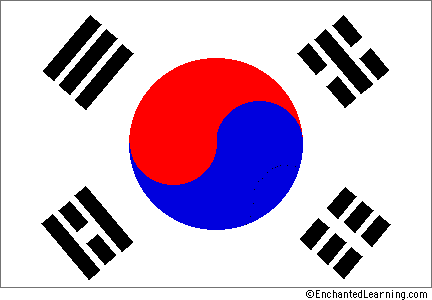
Let start off with a little basic information on South Korea! The following is a flag of South Korea:


The national flag, T’aegukki, is a unique symbol. The flag of T'aeguk ("Supreme Ultimate"), symbolizes the basic ideas of East Asian cosmology shared by the peoples in the Chinese culture area.

In the middle is a circle divided horizontally in two by an S-shaped line. The upper portion in red represents the yang, and the lower portion in blue symbolizes the yin depicting the yinyang principle of a universe in perfect balance and harmony.

The four trigrams at the corners of the flag also express the ideas of opposites and balance.

The three unbroken lines in the upper left corner represent heaven while the three broken lines placed diagonally in the lower right corner represent the earth. The trigram in the upper right corner represents water, while the one placed diagonally at the lower left corner represents fire.

South Korea is also known as the Republic of Korea and Seoul being its capital. South Korea is a fast emerging economic power and a developed country with a high standard of living, having a trillion dollar economy that is the 4th largest in Asia and 13th largest in the world. Also, South Korea is a trend setting country in Asia, exerting strong cultural influence over the continent in a phenomenon known as the Korean wave!